
18.02.2026
SONA 2026
It was a refreshing to note a sea-change in President Cyril Ramaphosa’s State of the Nation Address (SONA 2026) during which he differed from previous presentations by giving measured reassurances to business that government recognises the current constraints on growth in South Africa and is attempting to address them. Whilst his smile and apparent confidence gave no indication that the last thirty years of ANC rule may have led to such constraints, he spoke well. https://www.thepresidency.gov.za/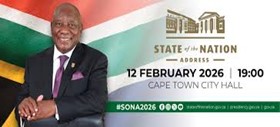
Amongst the many issues dealt with have been well covered in the media, such as the deployment of SANDF to the Cape Town flats and the recognition that gangsterism as the biggest threat facing South Africa. The President also gave a number of signals in his State of nationa Address which showed policy shifts that were encouraging, but always subject to the proviso that the Office of the Presidency can get all ANC ministers now in a GNU Cabinet to follow his lead including an incalcitrant SACP.
The Grid – Eskom to toe the line
Energy remains central to the recovery narrative. The President emphasised the easing of load shedding compared with past years, attributing this to regulatory reform, private generation uptake and improved performance at Eskom’s generation fleet. His commitment to expand Eskom’s transmission infrastructure, i.e the grid, and to encouraging outsiders to invest in the process thus following the already tabled plan for the future of energy, was good news. He has clearly crossed swords with his minister of electricity on the subject and who dearly wanted to keep the grid owned and run by Eskom.
The President has therefore not followed ANC/SACP centralistic thinking in some regards with SONA 2026. For many big electricity users, the risk of the grid going down will remain a factor but the finally adopted policy towards a more open electricity market and allowing in private sector to bid on transmission issues is encouraging.
Water, water – nowhere
As was expected and as if anybody in Gauteng didn’t know it, water security emerged as an equally critical economic issue. The President acknowledged deteriorating municipal water systems, infrastructure backlogs and wastewater failures as a crisis issue. SONA 2026 came at a point when water supply to most parts of Johannesburg was crippled and a top of the complaints list..
For the manufacturing industry, most commercial operations, food production, mining and chemicals, unreliable water supply presents operational and reputational risk. Government’s renewed emphasis on infrastructure maintenance and greater private sector participation indicates that reform is moving, however. The President sounded as if the message had finally got through and that something had to be done yesterday.
Ports and harbours stalled
The address also reinforced government’s commitment to introduce private operators into rail corridors and port terminals, particularly in logistics reform, to follow where the world road, rail transport and maritime operators have gone ahead without SA. Current inefficiencies in rail and port systems have constrained exports and dampened growth for some time. While structural reform at Transnet is gradual, the direction is clear…… but increased competition and operational partnerships are deemed necessary but whether Minister Barbara Creecy is the right person to shake things up and encourage movement forward remains to be seen.
State of Nation and the new world 
Electric vehicle incentives, green hydrogen projects and critical minerals development were highlighted by the President as being strategic priorities, as was the current industrial policy framed around localisation, green manufacturing and mineral beneficiation. A major peccadillo of President Ramaphosa is the necessity for a bullet train from Johannesburg to the coast whereas in SONA 2025, it was smart cities.
On health reform, the National Health Insurance framework was carefully referenced in terms of phased implementation but there was little mention of dates, no doubt due that the whole question of the future of NHI as a practical and financially sound project is before the courts.
For corporate employers, the risk of disruption to current employee healthcare arrangements appears limited in the near term. A supporter in government close to the new NHI department in DOH was heard to complain that with all the court proceedings and litigation processes currently lined up, NHI as proposed by the ANC could be halted for ten years.
The missing middle-class tradesman
For the first time ever in a great number of years there was presidential focus in SONA 2026 on local government. The yawning gap between provincial and local government, where absolutely nothing of consequence has been achieved, few services offered, equipment and buildings run down and no new development or infrastructure of note created, has been for years a feature of ANC government. Herein lies the big ANC/SACP/Cosatu failure, an area which has remained an enormous feeding trough for officials and the party few.
The President noted that the skills gap in technical and managerial fields remain a constraint to all major employers, employment and skills development remain GNU priorities. He promised public employment initiatives and technical training programmes and collaboration with private skills and training institutions. We have heard all this before, of course, but the President said this year he was going to get personally involved. Following his kept promises of personal involvement with Operation Vulindlela to improve the business investment climate, the promise to involve himself of the local government building and infrastructure development has hopes.http://chrome-extension://efaidnbmnnnibpcajpcglclefindmkaj/https://www.treasury.gov.za/Operation%20Vulindlela%20Summary%20Booklet%20March%202021.pdf
Where India succeeds
Looking back, local government plans as far back as 2005 have been tabled in Parliament to undertake such issues and produce the necessary artisanal class of worker, tradesmen, small business entrepreneurs and training bodies focused on building a South African middle class. In addition, every year since the National Budget appropriations started, funds have been supplied to execute such plans but there are few results recorded and little achieved.
How millions of rands have been spent in this area bu t unaccounted for leaving a void in this sphere is an epitaph of shame for COGTA and past ministers such as Nkosazana Dlamini-Zuma. Consequently, it was pleasing in this year’s SONA 2026 to hear that in the case of water department issues at the very least, a Bill is already drafted and shortly to come before Parliament criminalising officials for water project failure at local government level. Furthermore, in fifty cases individuals at local government level have been charged with theft or misappropriation of funds. However, much of what has occurred in both the area of re-building what was originally called the “homelands” and the funds directed to assist have now to be shrouded, there is no doubt, by efforts to recover from the years of theft and ignorance.
Problem vastly ignored
With little or no middle section of artisanal/tradesman society of consequence according to areas, this vacuum in trade skills has contributed to shortages in construction and manufacturing industries around the country. But legislation is on its way, the President said, to completely revise the developmental responsibilities of larger bodies in the provincial structure and reduce responsibilities in the smaller bodies and where there is no hope of a successful outcome.
National Treasury and SONA
Notably absent was any talk in SONA 2026 of sweeping tax increases and no radical regulatory shifts to add to the red tape burden. President Ramaphosa’s style and overall posture was one of continuity and fiscal caution, shying away from tax issues and obviously not wishing to add to the tax burden bearing in mind elections around the corner.
The Treasury emphasis in SONA appeared to be to consolidate on reforms already underway rather than launching new ideological programmes. The President referred several times to Operation Vulindlela, the joint initiative of the Presidency and National Treasury to accelerate the implementation of structural reforms, support economic recovery and to modernise and transform network industries, including electricity, water, transport and digital communications.
Crime
Early on in his speech, President Ramaphosa drew a gasp from many when he announced that members of the SANDF would be despatched to the Western Cape to assist SAPS in that area to combat gang warfare. Crime and corruption were addressed in strong terms, with emphasis on strengthening investigative and prosecutorial capacity with a reform programme already started in the National Prosecuting Authority under its new leader.
On the question of military support of the civilian power and calling up the army generally, we await confirmation that this was a mutual decision of the GNU cabinet. This is a major constitutional aberration, and the onus is upon Parliament to call for a double check. This will no doubt happen as Parliament gets down to work. Whilst strong arm tactics may be called for in the Cape Flats, doubts are expressed in many quarters on two issues.
Firstly, that the experiences of brutal behaviour towards innocent civilians that occurred during the Covid call-up will not be repeated. Secondly, whilst President Ramaphosa remains Commander-in-Chief, the apparent dubious political alignments of Minister of Defence, Angie Motshekga, and the even more erratic behaviour of General Rudzani Maphwanya, Chief of the South African National Defence Force (SANDF)- who also seems on his own political journey – are both clarified. Politicians with guns in our estimation are a dangerous breed and Parliament must call for policy commitment.
We are quite sure that in the next few weeks to follow, serious calls for an understanding of these matters will take place.
Not before time
Notable was the reference to the immediate implementation of lifestyle audits in SAPS; the further addition of 5,000 police to the current intake of 20,000; the concept of assisting municipalities with street lighting projects; and the emphasis on tracking, sale and storage of illegal goods. Regarding crime, the illegal cigarette industry came in for a mention, but Ramaphosa shied away from any in-depth comment in a matter which in the past has been of considerable embarrassment to the ANC.
Down to business
Other notable issues of SONA this year were that President Ramaphosa made specific reference to the fast tracking of a Whistle Blower’s Protection Bill through Parliament and the passage of a Water Services Bill, was designed to bring about changes of responsibility for water infrastructure development in smaller municipalities lacking skills and knowledge. Criminalising water department officials who were incompetent in their tasks or failed to meet targets was written into the proposed legislation.
Of particular interest was the presidential promise of the establishment of a state property body professionalised to the standard of any private sector equivalent to hold, develop, manage, sell and buy properties and land. It will be and charged with the handling of government’s 88,000 properties, plus all state land holdings.
In summation, SONA 2026 address signals a year of gradual stabilisation, said President Ramaphosa and the tone of his address suggests a government more aware of economic realities and increasingly aligned with the operational needs of industry.
For this alone, the GNU under President Ramaphosa has added value.
Patrick McLaughlin
editor