
Testing time in Parliament for all
Parliamentary rules have lasted world wide
(general/editorial)
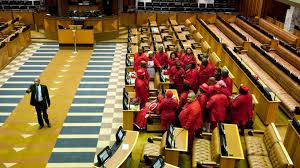
Whatever it looks like to the average South African on television at times and however clumsy parliamentary procedure may appear to be, democratic processes depend on the rules of parliament. Their observance is the only barrier to stand between a citizen’s freedom and the anarchy of dictatorial rule.
The trick, however, is not to be blinded by all the high drama and sink into irritation. What is being countenanced in Parliament is the winding down of a long-term power grab, perhaps even an attempted heist of freedom. The rules say the will of the majority must be carried out, and the rights of the minority must be preserved.
Needless to say, in the light of this, we are in dangerous waters when it comes to the democratic process.
False landlords
Parliament is yours and mine. It is neutral territory and it is owned by us citizens. A government official has to ask to come in to the premises and so does a judge. The precinct is not Cape Town, nor in Gauteng but a little bit of all the nine provinces. What is more, the members of parliament obey neither laws on information, dictates on speech and especially not the arm of SAPS. Instead, we as citizens are represented by parliamentary rules and a Constitution, the spirit of which is represented on our behalf by parliamentarians, or MPs
This where it has all gone wrong. Democratic processes have been warped somewhat but thankfully not destroyed. The coming elections may, or may not, help some of our politicians to clean up their act.
For twenty-five years, Parliament as an institution has tolerated a system of non-representative MPs, many of whom have broken into the state vaults and have stolen citizen’s money, Jacob Zuma being one of them. They are not ashamed of themselves in their search for loot either, since a good number have come back for more.
Major failure
What should be remembered perhaps is that for every single bad MP there are three good ones but unfortunately there are also also five ignorant of parliamentary produre and the rulebook. Few MPs have any idea of how to represent a citizen simply because the system has never been truly representative. Indeed, such a responsibility may have not occurred to many MPs. For the moment, all current MPs in the National Assembly are party appointments, part of a system that just has not worked well. The failure of the ANC generated Independents Candidates legislation insisted on by the Constitutional Court and drafted for the 2024 elections by the ANC, ensured political party control of Parliament for some time to come.
Now, and suddenly, things have changed but not completely. The recent 2024 election introduced an ANC without total power and what is being watched at the moment is maybe the exit of South Africa’s first try at the democratic process. Probably, also, it is the beginning of the end of a long soap opera of self-destruction for Zuma’s portion of the MK , the EFF of Malema and the possible exit of MPs mentioned in the dispatches of the Zondo Commission Report, who have never followed rules in any case
Time travel
What Roelph Meyer, Leon Wessels and our first President Mandela were looking for under the stress of CODESA was a way of orderly handover in a political sense. What was found met the constitutional call but after ten years and the start of cadre deployment, the Constitution has been found lacking in the call for accountability and responsible government. We are where we are, having to watch the results play out with a loose formation called the ANC wanting radical economic transformation, whatever that might be, assisted by SACP who have seperate idealogical motives to centralise power and realize the socialist state partially formed.
Looking in the mirror for the last twenty years, Parliament and its forty odd portfolio and select committees, have been making the legislation we live by accompanied by the chairpersons of those committees stamping ANC policy on every meeting held. Successive ANC presidents have therefore produced what we see today, endorsed by Parliament supposedly in the best interests of those who voted them to power. What you see is what you get.
Because of this emasculation of the parliamentary system and its rules and a Constititution which has failed to adress the issue of accountability for not following those rules, investment in South Africa has run into negative numbers. An example of this power play was the 20 twenty pieces of socialist legislation rushed through the National Assembly before elections, the queue for debating time being so short that rubber stamping suddenly became the order of the day and the rules overriden. Investors saw this. They shut their wallets.
Nothing but the truth
Where the rules have also been seriously broken is where government departments, fearful of their political masters, have not told the truth to Parliament. Only a cursory study was made on investigations into the sale of SAA following the massive corruption at PRASA, DENEL, Transnet and now PetroSA, not forgetting Eskom’s demise from a super-giant to a super patch-up job, in that case of a story of massive proportions in untruths told over the years to Parliament. At the time of this editorial, the Zondo Commission Report is awaited. As changes take place, “We the People” must establish a larger corner in Parliament where rules are followed; where government departments are forced to tell the truth and are admonished for any failure in governance.
Fingers crossed. Parlyreportsa.com is independent. We shall keep monitoring and reporting to business, trade and industry as South Africa enters a new phase of coalition- style government where there should be more space in Parliament for true democracy. Hopefully we might see the return of proper monitoring of government expenditure by chairpersons of committees who have the courage and conviction to serve the people and not just their party.
Patrick McLaughlin
Editor