
18.02.2026
Better than nothing, the GNU appears the only viable option
Possibly the most misunderstood feature of South Africa’s current political architecture is the Government of National Unity (GNU). It survives, it seems, because there is little alternative in the power game. It is fundamentally therefore a government born of necessity and as time passes the value of this arrangement increases simply because other options pose such enormous risk.
What was cobbled together after the 2024 election followed the ANC’s loss of its outright parliamentary majority. Still the largest party, with roughly 40% of the vote, it could no longer govern alone and was forced to seek partners. What we have now is a compromise, with the MKP being the largest opposition party as the DA joined the GNU, followed by the EFF—also in opposition but no friend of the MKP.
Together the GNU holds, by last count, a total of 287 out of the 400 seats in Parliament. The GNU is therefore the “government” because it exercises executive authority collectively, although in reality, the ANC as the largest party retains dominant influence through control of the Presidency and several strategic portfolios. 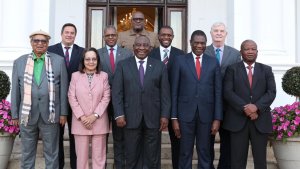
The GNU: Where we are
The current configuration of the GNU—anchored by the ANC, the Democratic Alliance, the Inkatha Freedom Party and the Freedom Front Plus—is given by experts a reasonable chance of surviving until the 2029 national elections. It may even weather the municipal elections later this year, which in any event do not directly affect parliamentary seat allocations.
It is reasonable to assume that the DA, now the second-largest party and arguably the only party showing sustained growth, will continue to see the advantage of consolidating power at local government and municipal level. Control of major metros, and a demonstrable record of delivery, would strengthen its hand in 2029. Geordin Hill-Lewis’s administration in Cape Town is frequently cited in this regard, while Johannesburg and eThekwini remain key strategic targets, with experienced DA figures such as Haniff Hoosen and Chris Pappas operating in the background.https://www.biznews.com/sarenewal/steenhuisen-gnu-das-growth-prospects
The mechanics
If the GNU is to stay around awhile, then it becomes important to understand how it works—particularly as political pressure will intensify ahead of the municipal elections, forcing all parties to reassess their positions in an increasingly complex power game. The GNU should eventually become the pivot of all the political happenings since, at the moment, too much is happening in separated silos for it to be cohesive. President Ramaphosa’s 2026 SONA address demonstrated some attempt of a cohesive approach.
Much of current discord in the GNU revolves around past service delivery, accountability and political direction. On accountability, the Auditor-General has repeatedly pointed out that only a small minority of municipalities (19%) are able to produce credible annual financial statements showing how public money has been spent. The AG’s office, however, lacks enforcement power under the Constitution—a structural weakness that has existed for years.
Given that most municipalities over the past quarter century have been governed by the ANC, the question naturally arises: how did this situation arise? The uncomfortable answer is that the governing party, protected by parliamentary dominance and a powerful presidency, has largely operated above meaningful accountability—to National Treasury, to Parliament and to the electorate.
Good points
For the first time, however, some form of internal restraint has emerged. While the GNU remains heavily weighted in the ANC’s favour through control of key Cabinet posts—a familiar feature of coalition governments globally—it nevertheless introduces an element of mutual dependence. That alone makes it worth keeping.
The GNU operates under a Statement of Intent signed by ten political parties, committing them to good faith, consensus-seeking and inclusive governance reflecting the composition of the National Assembly. This is unprecedented in South African history: a coalition spanning ideological divides from the hard left through to the centre-right, with smaller groupings in between. Internationally unusual, it may also be politically fragile—but in a divided society, potentially invaluable.
Off the record
The GNU is led by President Cyril Ramaphosa, with Deputy President Paul Mashatile serving both as deputy head of government and Leader of Government Business in Parliament. We cannot monitor it. There is no standing secretariat and no published minutes. Public insight is limited to occasional media statements or Presidency communiqués—a striking lack of opacity given the importance of the arrangement.
A key internal structure is the GNU Clearing House Mechanism, chaired by Mashatile. It exists to facilitate coordination and resolve disputes among GNU partners. It does not make final decisions, but it plays a crucial role in consensus-building. Each GNU party is represented, ensuring bargaining remains focused and timely.
The GNU-style Cabinet
Operationally, governance still occurs through Cabinet, constituted under the Constitution and accountable to Parliament. In this respect, the GNU differs less from previous administrations than might be assumed. Cabinet deliberations remain confidential, and executive authority continues to rest collectively with the President and ministers.
Where tension re-emerges is on accountability. For years, parliamentary oversight has been weakened by one-party dominance of portfolio committees, allowing ministers to evade scrutiny. Old habits die hard.
This helps explain current friction around foreign policy. Parliamentary committees have demanded explanations from the departments of International Relations and Defence over South Africa’s increasingly assertive alignment choices—including engagement with Iran, diplomatic actions against Israel, and foreign policy signalling undertaken with little parliamentary debate. These moves test not only constitutional norms, but the integrity of the GNU itself.
Key role
Deputy President Mashatile’s dual role places him at the centre of this balancing act. Yet controversial initiatives—from red-hot legislation such as the National State Enterprises Bill, BELA and the proposed National Transformation Fund, to foreign policy positioning—well-placed assessments suggest a strong likelihood that proposed changes to State-Owned Enterprises could shift operational control toward the presidency, potentially reducing parliamentary oversight. These initiatives are often communicated top-down, with little evidence of prior GNU consensus.
This has sharpened tensions within the DA. Senior figures, including Helen Zille, have openly questioned the ANC’s conduct, particularly its handling of Iran and its persistent hostility towards the government of Prime Minister Benjamin Netanyahu in Israel. Zille remains uncomfortable with the GNU arrangement. We acknowledge the Friedrich Naumann Foundation https://www.freiheit.org/liberal-workshop-south-africa/gogo-zille-jozi-and-fight-liberal-democracy
Why the animosity over Israel? Here, history intrudes and we can only give opinion based on past experiences. Among some older ANC figures, attitudes to Israel are shaped less by present realities than by political memory formed during the 1970s and 1980s, when Israel was perceived as having supported the apartheid state militarily during the Border War. For some, these experiences hardened into long-standing prejudice. For others, they remain unresolved political baggage sharpened by ideology.
This matters because foreign policy driven by historical grievance rather than contemporary national interest carries real risk. It also reveals something more troubling: an internal ANC dynamic that operates beyond GNU discipline, pursuing its own agenda while wrapping the country in unnecessary complications.
That internal force may ultimately prove more destabilising than any opposition party such as the EFF shouting from the sidelines. Issues between the ANC and the SA Communist party will be playing out in GNU relationships for some time to come.
Patrick McLaughlin
Editor