
Elections 2024: ANC told there can be no free lunches
20/5/24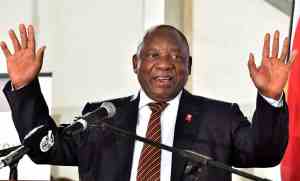
The NHI and earlier ANC promises of free health to the poor were substantiated by President Ramaphosa in a speech to the nation amidst a build up towards the May ’24 elections. The party’s final push for revitalization of SA health services was marked by a presidential announcement heralding the possible enactment of the National Health Insurance (NHI) Bill into law. The event was magnified into the status of a national announcement with a backdrop of Union Buildings in order to underscore, supposedly, the significance of the event.
What money?
Central to the announcement was the introduction of the phased universal healthcare program outlined in the NHI Bill, now signed into law, touted by many in the ANC as “free” and also to be gradually implemented over an unspecified period with no little in the way of any financial plan. This is likely to be the basis on which the Bill is to be challenged in the Constitutional Court as announced by union leaders of Solidarity….that there is no foundation of a serous financial plan in any part of the proposals but just a loose framework .
The little that there is in the way of finance mechanisms for this over-ambitious healthcare initiative comes from earlier discussions in Parliament involving future direct taxation income earnings, ideas only discussed and presumably structured towards higher tax brackets as a form of wealth tax.
Out of reach
Such an approach has been heavily criticized in media commentary, sparking concerns over the ability of Department of Health to be at any time capable of supplying a full range of health care and medical services countrywide ranging from primary care to general hospital treatments to ICU/high/emergency care and with the necessary staffing, professional services and infrastructure to meet the needs of 60 million people.
The imposition of mandatory state healthcare deductions in the form of straight tax contrasting sharply with the existence of sophisticated private medical aid subscriptions services, has left most SA white collar citizens with a fear of a forthcoming “wealth tax”. Critics argue that the Department of Health (DOH), lacks the necessary fiscal expertise for such a monumental undertaking.
Socialist overtones
In earlier parliamentary presentations to the health portfolio committee by Dr. Nicholas Crisp, now named as government Director of the NHI programme, the absence of any detailed financial documentation accompanying his proposals left opposition MPs cold. Throughout the period of debates and hearings, objections were raised in principle to the whole idea of universal health care at this particular stage of SA’s voyage through uncertain financial times or the ability of any existing state medical structure in SA able to implement same.
Opposition MPs complained that speculation existed in the market that SA had no intention of acting as if it understood the critical situation facing the country.
Not supported
In finalisation, the Bill was not supported by any opposition parties in final voting in both Houses. Initial funding for the extensive NHI scheme, estimated by Daily Maverick to surpass one trillion rands, encompasses infrastructure development, operational costs, and staffing and with its enormous financial demands, will necessitate a National Treasury Money Bill dedicated to bolstering the NHI fund indefinitely.
Looking forward, President Ramaphosa in his speech announcing that he had signed the Bill, proposed once again a collaborative approach wherein private sector entities, such as medical majors, play a role in supplementing government healthcare services. This suggestion contrasts sharply with criticisms from figures like Adrian Gore of Discovery, who stresses the need to fortify rather than undermine the private healthcare sector for effective national health schemes.
For the future
Acknowledging dissent from opposition parties, notably the EFF, the President acknowledged that the NHI implementation timeline remains uncertain, stating it maybe two years before any major shift towards any structural tax changes could even appear before Parliament. Nevertheless, an initial sum of R4.5bn would be transferred in the forthcoming budget as a start, remaining in an NHI Fund yet to be created.
The President’s call for support of the proposals turned his announcement into a clear punt for votes, but at the same time ignored the public outcry or expert opinions debunking the proposals mainly on the basis that the nation could ill-afford such grandiose plans.
Anticipating legal challenges, particularly in the Constitutional Court, the future of the NHI Act hinges on forthcoming rulings amidst the a constrained fiscal environment not suitable for healthcare reforms and re-equipping The adoption of any new governmental outcomes after the May elections could possibly frustrate ANC plans for universal health care
Patrick McLaughlin
editor
Patrick McLaughlin
editor